
Note: My Web pages are best viewed with style sheets enabled.
|
Note: My Web pages are best viewed with style sheets enabled. |
Unrated |
With the back yard on the north side of my house, west is to the left and east is to the right. Two features dominate my back yard: I have love-hate relationships with both The Tree and My Hill. The yard was extensively relandscaped in 2007 to repair the damage done by grading operations to repair My Hill.
The flat portion of my back yard is 45 feet deep (north-south) and almost 70 feet wide (east-west). The sides are bounded by walls of split-face concrete blocks, and the back is marked with a low slough wall at the toe of My Hill. Next to the house is a free-form concrete patio. Shaded by my two-story house on the south and The Tree on the north, the patio has no covering.
At the far north-east corner of the yard is a small, round, brick patio, just large enough for four chairs. Three-foot paths of decomposed granite meander around the lawn, separating it from shrub and flower beds along the side and slough walls. The main path starts at the west end of the large patio, runs north and then east, ending at the round patio. A second path begins at the east end of the large patio, branching, merging, and branching again to bound two additional beds. One of those branches ends at the circular patio; the other ends at a T-intersection with the main path.
The overall color scheme is green — the lawn and most of the foliage — with grey accents along both sides of the main path. Of course, additional color is provided by flowers, with blooms phased throughout the year.
The lawn surrounds The Tree and consists of red fescue (Festuca rubra), an ornamental grass that I allow to grow to a foot or more between mowing. (I have it mowed once or twice a year to 3 inches.) While not intended for the foot traffic normally associated with lawns, I can indeed walk on it; however, it grows thick enough to discourage casual walking.
Bordering the east end of the lawn, heavenly bamboo (Nandina domestica) alternates with variegated society garlic (Tulbaghia violacea 'Silver Lace') adjacent to the path. Farther into the lawn at that end are daylilies (various hybrids of Hemerocallis, including 'Stella de Oro' and 'Autumn Red'). Within the west end of the lawn are Artemisia 'Powis Castle' (A. arborescens × absinthium) and an artichoke (Cynara scoymus), providing gray accents against the green of the fescue. The artichoke grows mostly in the winter, provides large edible buds in the spring, and goes dormant in the heat of summer. At three places around the edge are dwarf citrus in containers: 'Eureka' lemon on the west end, 'Robertson' navel orange on the east end, and kumquat along the north side.
Fortnight lilies (Dietes iridiodes, also known as D. vegeta) and lilies of the Nile (Agapanthus orientalis) separate the lawn from the large patio on the west while a Gardenia jasminoides 'Veitchii' and bearded iris 'Wenatchee Skies' (I. germanica, pale blue with a hint of lavender) are to the east. Between, the lawn reaches the patio, interrupted by clumps of daylilies.
I have several other trees on my property, but none compare with The Tree, which is an evergreen ash (Fraxinus uhdei, sometimes called a shamel ash). When I planted it in late 1973 (or was it early 1974?) from a five-gallon can, it was a sapling with a trunk as thick as my thumb. Today, it is 3.5 feet in diameter at chest height (11 feet in circumference). Growing in the back, it can easily be seen from the street in front — towering over my two-story house — and even from some locations three blocks away. Near the center of the flat area of my back yard (about 24 feet from the house), the tree's branches now reach over my roof. Its total spread is greater than 50 feet.
The lowest foliage is about 15 feet off the ground. Thus, although the tree casts a solid shadow, air circulates freely beneath it. The shade is quite welcome on a hot summer day. However, the shade was far too dark for my original landscape plans and dictated the new landscaping that was installed in 2003 and then re-installed according to the same plan in 2007.
Surface roots — some over three inches in diameter — are a problem. I have found roots over an inch in diameter more than 30 feet from the trunk. Some roots seem to rise near to the surface and then dive into deeper soil, very much like a porpoise leaping and diving in the ocean. While the roots do not invade water lines, some grow close to the plastic pipes of my sprinkler system. Several times, the roots have grown enough to shift and break those sprinkler lines. Much of the labor installing my new landscaping involved removing surface roots from The Tree.
I did not know when I planted it that F. uhdei comes in male and female trees. This is a female. Every summer, she drops enough seeds just on my patio to fill a three-gallon bucket several times over. I have seedlings sprouting all over my lawn and flower beds. Behind some bushes, the seedlings may be two feet tall before I find them. The most significant weeds in my garden are annual grasses and ash seedlings; sometimes it seems the ash seedlings outnumber all other weeds combined. (The Zelkova serrata in the front yard is at least as old as The Tree. Not only has it stayed smaller, but it definitely also does not drop as much seed. Further, very few Zelkova seeds ever sprout.)
"Evergreen ash" is a misnomer. Only if the Santa Ana winds and overnight frost are both light throughout the winter, the leaves might remain green on the tree until they are pushed off by new spring growth. In most winters, my tree will drop its leaves (generally in December or January). The litter is far more than I can use as mulch and in my compost pile. Over a four or five week period, I fill the 50 gallon garden waste bin every week with nothing but ash leaves for trash collection (and eventual disposal in a composting program operated for Ventura County). Of course, the tree leafs out again quickly, sometimes turning green before I can finish raking the old leaves.
Someday, the oak in front will have a greater spread and far more mass than the ash in back. By then, the ash — which is not as long-lived as an oak — will be ashes in someone's fireplace. But the oak will never tower 50 or more feet into the air as does the ash today.
While my homeowner's insurance would fully cover any damage to the neighbor's house, the cost of removing this huge limb was entirely out of my own pocket. In the end, my neighbor's house escaped any damage.
Having described the central features of the flat portion of the garden, I now conduct a verbal tour of the shrub and flower beds in a counter-clockwise direction.
At the west end of the patio, in a narrow bed separating it from the air conditioner, I planted two azalea (Rhododendron indica) 'Pride of Dorking'. These azaleas have single flowers that are almost blood red.
On the patio a flower pot holds a spoon-flowered chrysanthemum (C. morifolium). Outside the kitchen window, there is a tiled service counter. In pots on the counter, I have hybrid amaryllis (Hippeastrum) and two kinds of orchid cactus (commonly called Epiphyillum but actually in the Hylocereeae tribe). I also root cuttings of various perennials in small plastic pots on this counter.
At the east end of the patio is a gas barbecue attached to a gas line that runs under the patio.
From the east end of my patio to the north-eastern corner of my house, a small triangular bed contains three Camellia japonica:
Because the house is not square on the compass, these shrubs get too much morning sun in the summer. While they grow and flower, they are not as vigorous as camellias that have all-day shade. To help them withstand the dry Santa Ana winds in the fall, they are heavily mulched with leaves and the output of my office shredder all held in place with small branches (mostly fallout from The Tree).
In front of the camellias, I planted a row of azaleas (Rhododendron indica, sometimes called sun azaleas). These are 'George Taber', with silvery pink flowers that have magenta freckles and streaks. These grow quite vigorously and need constant pinching; every two or three years, I prune them severely. Otherwise, they would hide the camellias.
Where this bed meets the path from the patio, there is a clump of purple crocuses (Crocus vernus) that bloom consistently every spring (something that is not supposed to happen in this mild-winter climate).
My dining-room window looks directly onto the camellia bed. In the late winter (when the camellias bloom) and very early spring (when the azaleas bloom), the blinds remain open all day so we can admire them.
A path of concrete stepping stones — black with exposed aggregate — separates the camellia and east beds. This path leads over to the east side of my house, a dead end where I keep my compost pile. The stepping stones are bordered on both sides by candytuft (Iberis sempervirens) with a greater mass on the east bed side than on the camellia bed side.
A block wall runs behind the east bed. Thus, the bed gets morning shade but radiated warmth into the evening. The bed begins with a volunteer clump of Sprenger asparagus (A. aethiopicus 'Sprengeri'), which extends into the side yard. In the summer, our tortoise sometimes hides and sleeps within this spreading clump.
*** Begin Right Sidebar ***
Shortly after the path leaves the east end of the patio and the camellia bed, it forks and then merges, surrounding a bed shaped like a teardrop with the point at the north and the rounded end at the south (towards the patio). A Christmas heather (actually a heath, Erica canaliculata 'Rosea', a variety different from the one in front) is in the center of this bed, surrounded by low-growing Cuphea hyssopifolia with tiny pink (almost magenta) flowers. Under everything else (and sometimes climbing over the others), pink clover (Persicaria capitata) is a ground cover.
*** End Right Sidebar ***
The main feature of the east bed is a 'Santa Barbara' peach tree (Prunus persica). This tree replaced a 'Ventura', which previously replaced a 'Golden Blush' peach. Peach trees decline in vigor after about 12-15 years, but I kept each of the first two a little longer than that. All of these varieties are freestone and do not require much winter chill. I did prefer the 'Golden Blush' over the 'Ventura'. 'Golden Blush' was truly freestone; the pit would fall out if you cut a peach in half. It was also more juicy and flavorful than 'Ventura', which might be considered semi-freestone. Since 'Golden Blush' is no longer available locally, I decided to try 'Santa Barbara', which was only recently introduced. It proved to be a good choice, with sweet, flavorful, juicy fruit.
Under the peach tree is a mixture of grape hyacinth (Muscari armeniacum) and red primroses (Primula polyantha). From the end of the candytuft, behind the peach tree, edible asparagus (A. officinalis) used to thrive. For over 30 years, we would eat asparagus once or twice a week for over a month in the spring. Then a very wet winter cause the asparagus to rot. Seedlings came up and promised us future vegetables, but another very wet winter killed those plants. Again, there are seedlings; but none of the plants are mature enough to provide edible spears.
Beyond the peach tree are columbines (Aquilegia hybrids) of mixed colors and a clump of 'Gold Galore' bearded iris. Statice (Limonium perezii) borders the path along with an 'Illumination Flame' foxglove (a rooted cutting from the plant in the west bed). I tried growing red hollyhocks (Alcea rosea) against the wall, but Cleopatra ate them all. At the end of the bed are Camellia sasanqua 'Yuletide' (upright with single red flowers), red Penstemon, and freesias (which have naturalized and come up every year in January or early February).
*** Begin Right Sidebar ***
The path intersection between the teardrop and circular beds is quite wide, wide enough for several 10-inch flower pots with herbs, placed on the path itself, on either side. Perennial herbs include peppermint (Mentha piperita), tarragon (Artemisia dracunculus), English thyme (Thymus vulgaris), sage (Salvia officinalis), oregano (Origanum vulgare), and bay (Laurus nobilis). When the weather permits, there is also basil (Ocimum basilicum), which sometimes persists through a mild winter for a second year.
Yes, we do use these herbs in our kitchen, along with the rosemary growing in front.
*** End Right Sidebar ***
The "merge" of paths at the north end of the teardrop bed is actually an intersection. Beyond the intersection, the paths again diverge and then curve. With the main path, they surround a circular bed.
A 'MacBeth' loquat (Eriobotrya japonica) highlights the center of the circular bed. Around it are six azaleas, alternating between Rhododendron indica 'Alaska' (single white) and R. indica 'Formosa' (single hot pink). Among them are 'Stella de Oro' and 'Autumn Red' daylilies, and cheddar pinks (Dianthus gratianopolitanus, also known as D. caesius). Between each adjacent pair of azaleas, sea pinks (thrift, Armeria meritima) were planted. However, our tortoise found them to be very tasty and chewed several to the ground, killing them. The missing sea pinks are being replaced with 'Goodwin Creek Grey' lavender (Lavandula lanata × dentata), using rooted cuttings from established plants.
A small brick patio is framed by the east, circular, and rose beds. On a small table on the patio is a potted Cymbidium orchid. I was told that, unlike tropical orchids, this can remain outside in the winter frosts unless we have an exceptionally severe frost. The climbing 'Peace' in the rose bed reaches behind the patio towards the last C. sasanqua in the east bed, in the corner of the garden. From the patio to the slough wall — dividing the east and rose beds — is a very short path of stepping stones so that I can operate the manual sprinklers for My Hill without stepping into mud.
At the back of the yard, just in front of the slough wall at the bottom of My Hill, this bed highlights six roses. From east to west, they are:
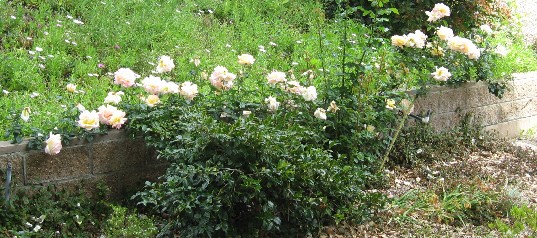
This is a single plant with canes stretched along the top of a slough wall. In front of the rose is a Camellia sasanqua 'Chansonett', which had alredy bloomed. The photo was taken on 21 April 2022.
The climbers are planted right against the slough wall. Because climbing roses tend to blossom from side shoots arising from horizontal canes, they are trained along the top of the low wall (about two feet high). I inserted screw eyes into the top of the wall and use twine to hold the long main canes down. The horizontal main canes produce many vertical side shoots to distribute the flowers over many feet. 'Peace' covers more than 20 feet of wall. 'Don Juan' is a new planting, which is not yet trained on the wall; it replaced a prior climbing 'Dublin Bay', which lacked sufficient vigor.
*** Begin Right Sidebar ***
Just west of the 'Arizona' rose is a large oblong pot with a hybrid Alstroemeria. This sits on the main path at its T-intersection with a path that separates the circular bed from the lawn.*** End Right Sidebar ***
Near where the bed meets the east bed, there are pink Penstemon. Against the wall, between and behind the roses across the length of the bed, I planted dwarf Burford holly (Ilex cornuta 'Burfordii Nana'). Scattered through the bed are "spring" bulbs and bulb-like perennials: freesias, lady tulips (Tulipa clausiana), and narcissus ('February Gold' and others). (Actually, although called "spring" bulbs, many bloom in January and February.) The bed contains more 'Stella de Oro' daylilies. There are low-growing, sprawling Camellia sasanqua (medium pink 'Chansonett', and 'White Doves') and Cuphea hyssopifolia with tiny white flowers. A ground cover of pink clover (Persicaria capitata) was planted. (Competing with the pink clover, cinquefoil (Potentilla neumanniana) was accidentally introduced into this bed.) Along the path are evenly spaced clumps of blue fescue (Festuca glauca), providing the same gray accents against the green ground cover as the Artemisia and society garlic do in the red fescue lawn and in the west bed.
This bed is a favorite of Cleopatra (an ancient beauty), my California desert tortoise. Cleo loves to eat rose petals. Not only does she pick up most of the fallen petals, but I once saw her bang her shell against a bush to knock petals loose from a flower that had just matured.
A branch of the main path leads to My Hill and separates the west bed from the rose bed. This ends with steps to help me climb over the slough wall and onto My Hill. One additional clump of blue fescue is on the west of this path branch, balancing the nearby clump in the rose bed.
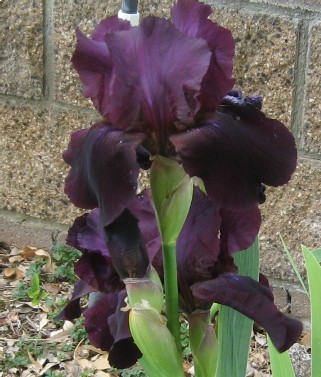 Adjacent to the steps is a clump of 'Study in Black' bearded iris (purple so very dark that it seems black). In the far north-west corner of the bed is a pineapple guava (Feijoa sellowiana, aka Acca sellowiana). It has abundant fruit that is quite tasty. If I don't cut it back every two or three years, it can grow 15 feet high and just as wide. I prune it to expose the interesting pattern of branches. Then it resembles a small, shrubby olive tree with the same gray-green leaves and pealing bark. In front of the guava are candytuft (Iberis sempervirens) and freesias.
Extending almost from the slough wall to well south of the guava, four Artemisia 'Powis Castle' balance the Artemisia in the lawn, just across the path. Just south of the guava is a clump of white Crinum (C. bulbispermum × moorei 'Album'), an evergreen bulb that is quite fragrant when it blooms.
Next is a clump of white 'Henry Shaw' bearded iris. When this one and the almost black 'Study in Black' are both blooming, the effect is excellent. In front of the iris are white 'Mount Hood' daffodils. From there to the south end of the bed, 'Spencer Tracy' narcissus (orange cup with a white saucer) are scattered.
From the middle (where the bed is quite narrow because of the curve of the path) to the south end of the bed, there are dwarf myrtle bushes (Myrtus communis 'Compacta') against the wall. As the bed widens again at the south end, 'Batik' bearded iris (royal blue with white streaks) is near the edge.
Along the edge of the bed, occasional clumps of variegated society garlic (Tulbaghia violacea 'Silver Lace') are found from north of where the bed narrows all the way to where the path ends at the patio. Throughout the bed, from the candytuft to the star jasmine, cinquefoil (Potentilla neumanniana) grows as a ground cover.
*** Begin Right Sidebar ***

Pattern of Wax-Leaf Begonias Around Raised Bed
(Tangelo is the green circle in the center.)
*** End Right Sidebar ***
Where the myrtle ends, I created a raised bed by setting ornamental concrete blocks in a square, one block high and two blocks to each side (without any mortar). Inside the bed, I planted a semi-dwarf tangelo (Citrus reticulata × paradisi 'Minneola', a cross between a tangerine and a grapefruit). My heavy clay soil can be a problem for citrus, which requires very good drainage. That is why I resorted to a raised bed. I also improved the soil within the raised bed — above and below the surrounding level — with wood chips (from the tree service that trims The Tree), coarse sand, peat moss, and compost; these amendments should also help the drainage. The blocks forming the raised bed are on edge, with the holes exposed. After filling those holes with my potting mix, I planted wax-leaf begonias (B. semperflorens) in them, alternating green-leaf and red-leaf varieties and alternating white, pink, and red flowers, a cycle of six different varieties (photo  ).
).
Where the west bed meets the patio, there is a clump of Aztec lilies (Sprekelia formosissima). At the very end of the bed — after the path meets the concrete patio — is a trellis, which star jasmine (Trachelospermum jasminoides) completely hides. The star jasmine also forms a thick ground cover between the trellis and the tangelo. Between the Aztec lilies and star jasmine is an 'Illumination Flame' foxglove (Digitalis purpurea × canariensis, also known as Digiplexis because Digitalis canariensis was previously known as Isoplexis canariensis).
This brings us back to the concrete patio and the end of the tour. Beyond the trellis is the west side yard, where we keep our trash bins. The paved walkway from the patio and through the side yard goes through a gate and leads to the front yard on the side where I have more roses.
During another severe rainstorm on 9-10 January 2005, My Hill again failed. On those two days, 3.98 inches of rain fell, with a total of 6.82 inches between 3:00am on 7 January and 7:00am on 11 January. For many areas of southern California, the winter of 2004-2005 brought record-breaking rainfall totals. Strangely, although only My Hill was professionally repaired from the 1992 failure — the owners of other four affected homes merely tossing the dirt back up onto their slopes — only My Hill failed in the 2005 storm. Repairs were finally accomplished in 2007 at a cost nearly five times greater than the cost of the 1992-1993 repair. This time, I needed a geotechnical engineering firm to prepare a soils and geology report and a separate civil engineering firm to prepare a grading plan. Again, I used a professional grading contractor.
For the 2007 repair of the 2005 failure, all existing vegetation had to be removed. What follows reflects the landscaping following the 2007 repair.
The engineering plans for repairing My Hill assert a 2-1 slope (about 27°). I think it is really closer to 3-2 (34°). In any case, it is sufficiently steep that I only climb it when truly necessary. Several times, I have fallen on it, wrenching various parts of my anatomy. Once I actually fell off it, tumbling over the slough wall at the bottom.
My Hill rises about 30-40 feet from the flat part of my back yard. When The Tree is dormant, I can stand at the top of My Hill and inspect the roof of my two-story house. At the foot is a low slough wall, about two feet high. Although most persons who see it think the wall is a retaining wall, it is not engineered to hold My Hill in place; it merely stops loose soil and minor erosion from running off the bottom of My Hill and into the beds.
Several feet below the top of My Hill is a cross-slope V-ditch to catch runoff from the properties above. This empties into a down-slope V-ditch near the midline of My Hill. This V-ditch empties into a catch box extending beyond the slough wall and into the rose bed. Deep within My Hill are four drain lines to catch water percolating into the soil; these empty into 4-inch pipes on the surface, running parallel and adjacent to the down-slope V-ditch. The drain lines and the catch box empty into underground pipes that run to the front of my property and, in turn, empty into the street gutter. Embedded in My Hill at 12-inch intervals is a heavy plastic mesh (Geogrid), which limited the digging of planting holes; this mesh runs 7 feet horizontally into My Hill.

West Side of My Hill
This photograph was taken in mid-March when the African daisies were in full bloom and the 'Black Monukka' grape vine had not yet leafed out. Note the cross-hill and down-hill V-ditches at the top and right edge of the photograph. The slough wall at the bottom has steps to provide access onto My Hill from the flat area of the back yard.
My Hill is now landscaped according to recommendations from the geotechnical engineer and the Ventura County Public Works Agency (which provided an extensive plant list). Two negative recommendations are iceplant and trees. Iceplant (which used to be highly recommended on slopes) is now discouraged because it becomes very heavy when thoroughly watered, but its roots do not go sufficiently deep to hold it in place. It will not only slide down a hill but may also carry the surface of the hill with it. Trees do root deeply; however, they rock back and forth when the wind blows, breaking up the surface soil around their trunks. During a heavy rainfall, water will penetrate too quickly to the subsoil, leading to a surface failure.
Up the sides of My Hill are Rhaphiolepis 'Majestic Beauty', a hybrid of uncertain parentage (possibly R. indica × R. umbellata or R. indica × Eriobotrya japonica). Across the east part of the top are coyote bush (Baccharis pilularis), which are volunteers that were not planted. (The west part of the top is somewhat bare, possibly the result of the neighbor there carelessly using an herbicide.)
As required by Public Works Agency, My Hill is planted with a ground cover, a mix of white and purple African daisy (Osteospermum fruticosum) and English ivy (Hedera helix). My hope is that the ground cover will grow into the V-ditches and hide them. However, I will have to keep the bottom of the cross-slope V-ditch clear. The ground cover in the down-slope V-ditch will trap leaves that would otherwise clog the drain in the catch box.
About a fourth of the way up from the bottom and a third of the way in from each side, a grape vine was planted. On the east is 'Perlette' (white); on the west is 'Black Monukka' (red). Just below the cross-slope V-ditch at the top of My Hill and to the right of the down-slope V-ditch is a third grape vine, 'Flame'. All three are Vitis vinifera, European grapes that were obtained as rooted cuttings instead of grafted onto American rootstocks. Their fruit is seedless, sweet, and quite good. These are supported by steel posts and wire rope. In the winter, the grape vines are pruned to grow along the wire rope. In the summer, the new shoots are tied to the wire rope and trained along it.
I tried growing bush anemones (Carpenteria callifornica) near the top of My Hill, one on each side. On the east side, this California native seems to have become established; but on the west side, several attempts to grow it have all failed. I have stopped trying there.
Updated 3 July 2022
 Main gardening page |
 David Ross home |
 |
